
Real County Court Records After Arrest
A Real County arrest can create three tracks at once: the sheriff booking record, the prosecutor's charging review, and the court case record. The jail may know the arrest charge first. The prosecutor may then file a complaint, information, or indictment with different wording, added counts, reduced counts, amendments, or dismissals. The court record is the better place to confirm filed charges, hearing dates, case number, disposition, and conviction status.
Custody and booking details belong with Real County jail inmate records, while booking photos belong with Real County jail mugshots. Court records after a jail arrest answer a different question: what the court case says after a prosecutor files or declines charges. That difference matters because a booking entry is an arrest label, not proof of conviction.
Search Court Records After Arrest
Start with re:SearchTX for statewide Texas court case search, then use Real County clerk channels when a case does not appear, needs certified copies, or belongs in an older or locally maintained file. The Real County District Clerk page lists D'Ann Roosa. The clerk phone listed in county materials is 830-232-5202, and the district clerk page warns users to use realcl@hctc.net rather than an older internal email.
- Get the booked name and approximate arrest date from the sheriff or booking record.
- Identify whether the matter appears to be JP-level, county-level misdemeanor, felony, warrant, or out-of-county hold.
- Search re:SearchTX by defendant name, case number if known, and Real County or the specific court filter when available.
- If no result appears, call the County/District Clerk at 830-232-5202 for filing status or copy instructions.
- Use prosecutor contacts for charging-process questions, not as a substitute for clerk record copies.
The re:SearchTX portal is the statewide court-record search channel identified in the research file.
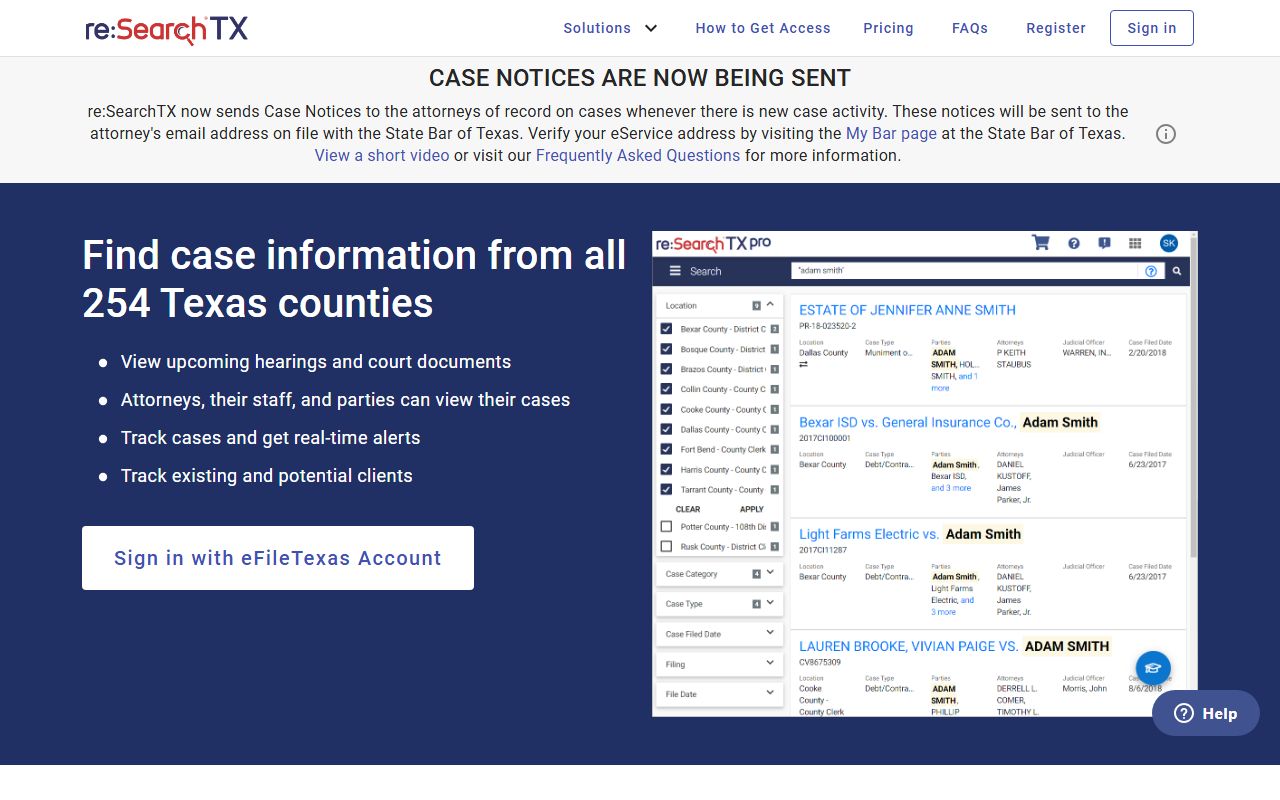
Portal access can vary by role, record type, court, and document, so the clerk remains the key fallback for Real County case status.
Real County Case Search Fields
The research captured a partial re:SearchTX field inventory. Use the most precise identifier available. A case number is stronger than a common name. A county or court filter helps keep other Texas cases out of the results. Some records or documents may require account access or may be limited by law, court rule, or user role.
| Field Label | Type | Required | Options / Format Notes |
|---|---|---|---|
| Name / party search | Text | One search path | Search by defendant or party where access is available. |
| Case number | Text | One search path | Best when the clerk, citation, or court notice provides the number. |
| County / court filter | Filter/dropdown | Optional or varies | Use Real County or a specific court if available. |
| Date range / case status | Filters | Optional or varies | Portal options vary by access level. |
| Login / account | Account | May be required | Document access can differ from public search access. |
Real County Court Contacts
Small-county court records often require direct clerk help. Real County's clerk channels, Justice of the Peace, County Attorney, and District Attorney each serve a different function after arrest. The clerk maintains the case file. The JP may handle initial or lower-level matters. Prosecutors decide how charges are filed, amended, reduced, rejected, or presented to a grand jury.
County/District Clerk
Honorable D'Ann Roosa
PO Box 750, Leakey, TX 78873
830-232-5202
Fax: 830-232-6888
Email: realcl@hctc.net
Justice of the Peace
Honorable Dianne Rogers
Real County Courthouse, 146 S. US Hwy 83
PO Box 1430, Leakey, TX 78873
830-232-6630
Fax: 830-232-4898
Prosecutor Contacts
District Attorney Christina Mitchell
830-278-2916
Real County District Attorney page and 38th Judicial District Attorney
County Attorney Bobby Jack Rushing: 830-232-6461
Charges Filed After Arrest
After arrest and booking, law enforcement sends reports to the correct prosecutor. The prosecutor may file, reject, amend, reduce, or present charges to a grand jury. A misdemeanor may proceed through a complaint or information. A felony generally proceeds through a grand-jury indictment unless waived or handled under another Texas procedure. The court clerk, not the jail, is the source for the final case number and court record.
| Document | Who Uses It | What It Means |
|---|---|---|
| Complaint | Sworn complainant, officer, or prosecutor path | Sworn charging document used in Texas criminal procedure. |
| Information | Prosecutor | Prosecutor-filed charging instrument, often tied to misdemeanors. |
| Indictment | Grand jury | Grand-jury charging instrument, generally used for felony prosecution. |
Note: The jail charge is an arrest or custody label; the court charge is the formal allegation filed in the court case.
Real County Charge Status
Charges can change as a case moves through court. A charge may be pending, amended, reduced, added, dismissed, or resolved by plea or verdict. A warrant or hold can also affect release even when a bond amount exists. Search results should be read with the docket date and court action, not just the first charge label.
| Status | What It Means | Where to Verify |
|---|---|---|
| Pending | The filed allegation remains open. | re:SearchTX or the County/District Clerk. |
| Amended or reduced | The filed charge changed from an earlier label. | Court docket and clerk file. |
| Added count | More than one filed allegation may exist after prosecutor review. | Court case record. |
| Dismissed | The court case or charge was dismissed, but history may still require expunction or nondisclosure review. | Clerk record and court order. |
| Convicted | A plea, verdict, or judgment produced a conviction. | Judgment and sentence record. |
Bond After Real County Arrest
Real County did not publish a standalone bond page in the official materials located. Bond information should be checked through the sheriff, Justice of the Peace, County/District Clerk, or relevant court after the magistrate sets conditions. Common Texas release types include cash bond, surety bond, personal or PR bond, and no-bond holds. A hold from another agency can block release even if a separate charge has a bond amount.
| Bond Type | How It Works | Real County Note |
|---|---|---|
| Cash bond | Full cash amount posted with the court or jail. | Accepted payment methods were not published; call first. |
| Surety bond | Licensed bail bond company posts bond for a fee. | Texas permits commercial bail. |
| Personal / PR bond | Release on promise to appear, sometimes with conditions. | Depends on magistrate or court decision. |
| No-bond hold | Bond will not release the person at that moment. | May involve a warrant, parole matter, ICE, another county, or court order. |
| Detainer | Another agency asks for custody or notice. | Can affect release after local bond is posted. |
Warrants and Court Records
No official Real County active-warrant search page, sheriff warrant list, most-wanted page, or warrant lookup form was located in official county sources. Warrant questions should use the sheriff at 830-232-5201, the Justice of the Peace at 830-232-6630, the County/District Clerk at 830-232-5202, re:SearchTX where a visible case exists, or the county Chapter 552 public-information process for releasable records.
If a warrant leads to booking, VINELink or a sheriff custody answer may update before the court file shows every docket event. Real County's small capacity and housed-elsewhere reporting also matter for warrants. A person arrested on a warrant may be tied to a Real County case but physically held in another facility.
Charges vs Convictions
A charge is an accusation filed or carried in a case. A conviction is the result of a plea, verdict, or judgment. Court records after a jail arrest can show both, but they should never be treated as the same thing. A dismissed charge can remain visible unless another lawful process limits public access.
| Point | Charge | Conviction |
|---|---|---|
| Stage | Accusation or filed allegation. | Final result by plea, verdict, or judgment. |
| Proof level | Not proof of guilt. | Reflects a legal finding or plea. |
| Record source | Charging document and docket. | Judgment, sentence, and disposition fields. |
Sealed vs Expunged Records
Texas uses terms such as expunction and nondisclosure. The Real County research did not identify a county-specific clearing form, so the correct source is the court file, state law, and qualified legal advice. Expunction is commonly described as a court-ordered destruction or return of eligible arrest records. Nondisclosure limits public disclosure of certain criminal-history records. Eligibility depends on the case result and Texas law.
| Point | Nondisclosure / Sealed | Expunction |
|---|---|---|
| Public visibility | Public access is limited by court order. | Eligible arrest records may be destroyed or returned. |
| Record effect | Some agencies may retain access under law. | Treated much more strictly when granted. |
| Verification | Check the signed order and clerk record. | Check the signed expunction order and affected agencies. |
Restricted Court Records After Arrest
Texas Government Code Chapter 552 presumes access to government information unless an exception or confidentiality law applies. Juvenile records, sealed or expunged matters, protected personal information, some medical information, active investigations, and some law-enforcement material may be withheld or redacted. Texas Government Code Chapter 411 also governs criminal-history dissemination and access to state criminal-history systems.
Important: Court records after a Real County arrest may show accusations, not convictions, and restricted records require clerk or court verification.